| | 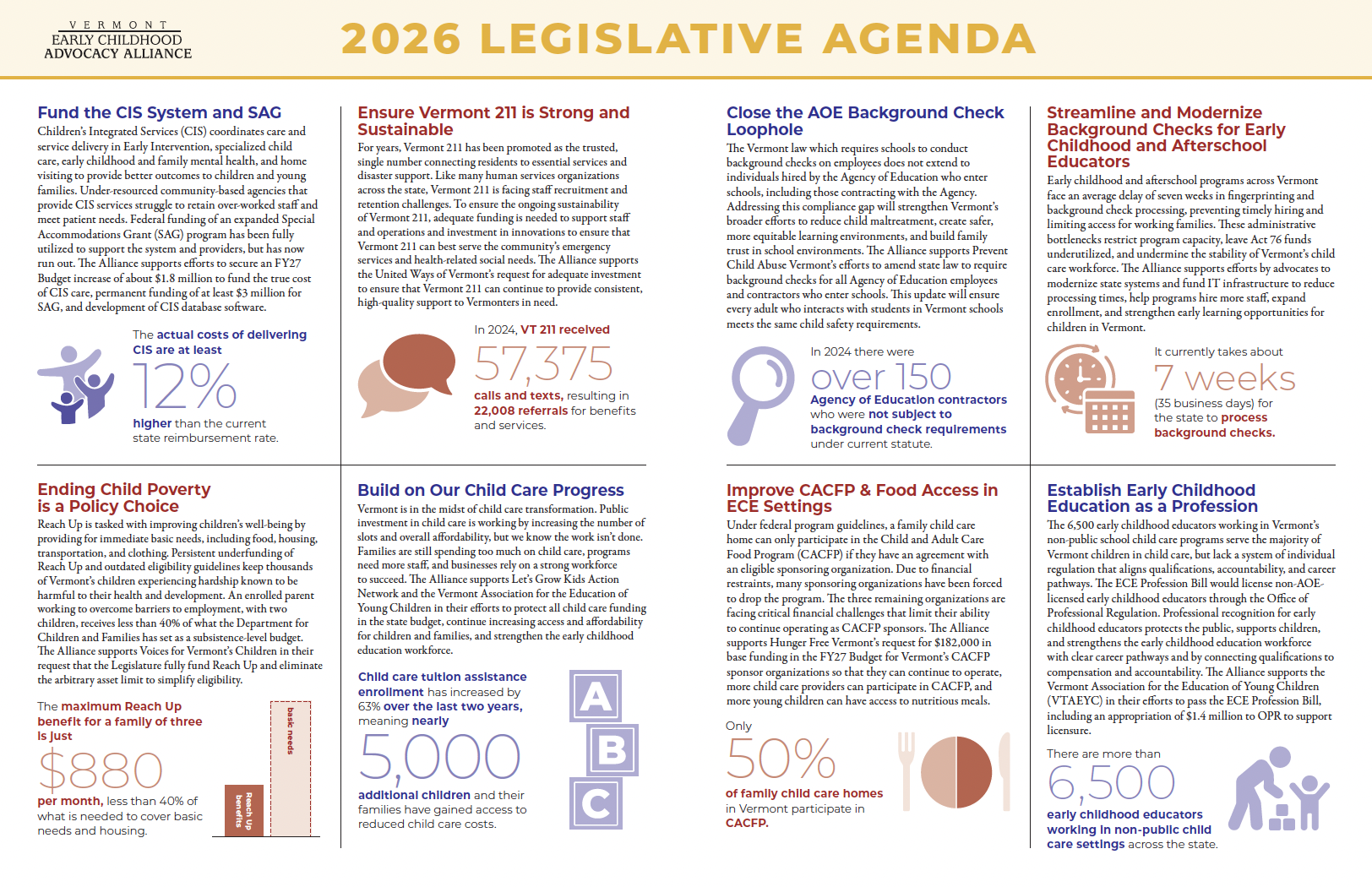 | Alliance Releases 2026 Legislative Agenda The Alliance's Legislative Agenda is crafted annually in partnership with early childhood organizations that are advancing policy solutions through the legislative process related to health, safety, food security, economic security, and early childhood education. The issues on our ‘26 Agenda, listed below, were selected by the Alliance's 21-member Steering Committee. One or more lead organizations will direct legislative and advocacy strategy on each issue. A downloadable PDF of this year's Legislative Agenda is available on the Alliance's website. We look forward to working together! For questions, please contact Matt Levin, Executive Director at [email protected]. | | | | Issue Summaries: Background: Children’s Integrated Services (CIS) coordinates care and service delivery in four key areas – Early Intervention, specialized child care, early childhood and family mental health, and home visiting – to provide better outcomes to children and young families. Recent state investments have not substantially improved the ability of the under-resourced community-based agencies that provide CIS services to retain over-worked staff and meet patient needs. A study conducted by Burns and Associates in 2024 determined the actual costs for CIS providers were 12% higher than the current reimbursement rate. Federal funding of an expanded Special Accommodations Grant (SAG) program has been fully utilized to support the system and providers, but has now been fully expended. Proposal: The Alliance supports efforts to secure: 1) an FY27 Budget increase of about $1.8m to allow for full funding of the per member/per month rate of $738 identified by the recent study of the true cost of care; 2) identification of a permanent funding source that will provide at least $3 million in annual funding to the SAG program; and 3) full funding for the development of CIS data management software. Lead Organization: Vermont Early Childhood Advocacy Alliance | | | | | Background: Vermont is in the midst of a child care transformation. Since Act 76 was passed in 2023, increased public investment has lowered child care costs for thousands of families, increased compensation for early childhood educators, and allowed new programs to open and existing programs to expand. Over the past two years, over 100 new child care programs have opened, over 1,700 new child care spaces have been created, and child care tuition assistance enrollment has increased by 63%. But families are still spending too much on child care, programs need more staff, and businesses rely on a strong workforce to succeed. Proposal: The Alliance supports Let’s Grow Kids Action Network and the Vermont Association for the Education of Young Children in their efforts to protect child care funding in the state budget; increase access and affordability for children and families; and strengthen the early childhood education workforce. Lead Organizations: Let’s Grow Kids Action Network (LGKAN) and Vermont Association for the Education of Young Children (VTAEYC) | | | | | Background: SNAP, known in Vermont as 3SquaresVT, is a federal nutrition program that provides monthly funds to low-income people to buy groceries. 3SquaresVT is administered by the VT Department for Children and Families, which reviews applications and determines eligibility. The federal reconciliation package passed July 2025 shifts a higher percentage of the cost to states to administer SNAP, and will require Vermont to cover 25% more of the cost beginning October 1, 2026. This change will mean an estimated $8.4 million annual increase in costs to Vermont, which would amount to approximately $6.3 million in costs for State Fiscal Year 2027. Adequate state funding to continue operating 3SquaresVT at current levels will ensure greater food security and health outcomes for families with young children. Proposal: The Alliance supports Hunger Free Vermont’s request to the Legislature to appropriate the necessary state funding to cover the increased cost to administer 3SquaresVT. This program must remain available, accessible, and functional for Vermonters, and for families of young children in particular, who depend on 3SquaresVT to put food on the table at home. Lead Organization: Hunger Free Vermont | | | | | Background: The State of Vermont does not raise enough revenue to meet Vermonters’ needs. This lack of sufficient state revenue has resulted in chronic underfunding of state programs and services, including programs that impact young children – investments in early childhood health and welfare, economic security, food security, and more. This underfunding will be exacerbated by federal funding cuts, putting added pressure on the state budget and further reducing the State’s ability to ensure that all people have the basic resources and support that they need to thrive. At the same time, wealth and income inequality have grown, resulting in a population of wealthy Vermonters who are able to pay significantly more in taxes than they currently are – and who are set to receive significant federal tax cuts due to recent Congressional action. The state must raise revenue from those who can afford to pay. Proposal: The Alliance supports the Fair Share for Vermont Campaign in advocating for a tax increase on all people in Vermont earning more than $500,000 per year. This tax increase would claw back a portion of the $57,000 average annual federal tax cut that the wealthiest Vermonters are set to receive under the One Big Beautiful Bill Act, and will generate over $100 million annually for the state to improve public goods and services and increase resilience to federal funding cuts. Lead Organization: Fund Vermont’s Future Campaign | | | | | Background: Homelessness in Vermont impacts at least 4,500 people, including more than 1,000 children, and represents one of Vermont’s key barriers to early childhood health, safety, food security, and education. With community shelter capacity hovering at about 600 available spaces, access to the statewide General Assistance (GA) emergency housing program represents the only viable path to obtain shelter for many impacted families. Despite this reality, eliminating funding for statewide emergency shelter has been a priority of the Scott Administration. As a result, significant cuts to our emergency shelter system have left hundreds more individuals unsheltered. Last year, while our total population of homeless individuals remained largely steady, unsheltered homelessness rose by approximately 63%. Proposal: The Alliance supports efforts led by the ACLU of Vermont to reduce or eliminate unsheltered homelessness by preserving and expanding access to the GA emergency housing program for Vermont individuals and families experiencing homelessness. At a minimum, advocates seek to retain funding equal to FY26 Budget one-time and base appropriations of about $39 million. Lead Organization: The American Civil Liberties Union (ACLU) of Vermont | | | | | Background: Vermont enacted legislation last session to begin the process of enabling Vermont families covered by Medicaid to have access to doula services. Doula support is an evidence-based policy that improves outcomes for babies and their families and promotes safer, less expensive births. Doula support is also correlated with improved infant-parent bonding and less postpartum depression and anxiety throughout the perinatal period, and increases equity in our community. This legislation, Act 50 (S.53), instructs the the Office of Professional Regulation (OPR) to create a voluntary certification process for community-based perinatal doulas and requires the Department of Vermont Health Access (DVHA) to begin the process of making a formal request to the federal government to include doula services during the prenatal and postpartum periods as well as during labor and delivery in the State Medicaid Plan. Proposal: The Alliance supports the efforts of the Doula Association of Vermont to ensure that OPR and DVHA implement Act 50 as directed by the Legislature. Lead Organization: Doula Association of Vermont | | | | | Background: Parent Child Centers (PCCs) are a critical part of Vermont’s system of care for young children and families. The 15 designated PCCs serve families throughout the state by offering a set of eight Core Services that promote healthy development, prevent maltreatment, and support family stability. These services are designed to be flexible and responsive, whether a family needs emergency financial assistance, parenting support, or help navigating complex benefit systems. The work that PCCs do to help families access basic safety net programs and services is becoming increasingly important as critical supports that have protected the most vulnerable families – those with noncitizen members, parents who have lost jobs or are underemployed, and those who are without stable or safe housing – are being reduced or are more difficult to access. Proposal: The Alliance supports the Vermont PCC Network’s request for a $1.88 million increase to the PCC Integrated Grant. This funding will ensure that PCCs have staff capacity to serve more families who need support; to expand clients’ access to concrete supports that address immediate needs and buffer young children from extreme hardship; and to implement statewide benefits navigation, to help families enroll in and maintain eligibility for federal programs such as 3SquaresVT, WIC, Medicaid and other health insurance, and affordable housing. Lead Organization: Vermont Parent Child Center Network | | | | | Background: Federal funds make up about a third of the state’s overall budget, and a critical percentage of funding for many programs serving Vermont’s families with young children every day, including Reach Up, 3SquaresVT, emergency shelter and housing supports, Medicaid, and child care. The Federal FY26 Budget that is eventually passed by Congress, whether comprehensive or piecemeal, is likely to include substantial cuts to this funding. Proposal: The Alliance will support strategic, timely, and coordinated advocacy responses to federal funding reductions that ensure our community’s voices are heard, and that core needs are not unnecessarily pitted against one another. We will also support efforts to find increased state revenues to fill in gaps as possible. Lead Organization: Vermont Early Childhood Advocacy Alliance | | | | | Background: Reach Up is tasked with improving children’s well-being by providing for immediate basic needs, including food, housing, transportation, and clothing while parents work toward economic stability. Persistent underfunding of Reach Up and outdated eligibility guidelines keep thousands of Vermont’s children experiencing hardship known to be harmful to their health and development. An enrolled parent working to overcome barriers to employment, with two children, receives just $880 to cover basic needs, including a $268 housing allowance. This amount is less than 40% of what the Department for Children and Families has set as a subsistence-level budget. This policy choice endangers children and contributes to Vermont’s homelessness crisis. Persistent poverty also increases the chance that children are separated from their families and placed in foster care, which is both costly and traumatic. Unlike other safety net programs, Reach Up imposes an arbitrary asset limit when determining eligibility, which serves as a counterintuitive penalty against families saving for housing, education, training, or to buy a car – all investments in long-term financial security. Proposal: The Alliance supports Voices for Vermont’s Children in their request that the Legislature fully fund Reach Up and eliminate the arbitrary asset limit to simplify eligibility. Lead Organization: Voices for Vermont’s Children for the Vermont Reach Up Coalition | | | | | Background: For years, Vermont 211 has been promoted as the trusted, single number connecting residents to essential services and disaster support. Like many human services organizations across the state, Vermont 211 is facing staff recruitment and retention challenges. To ensure the ongoing sustainability of Vermont 211, adequate funding is needed to support staff and operations, and investment in innovations to ensure that Vermont 211 can best serve the community’s emergency services and health-related social needs. Proposal: The Alliance supports the United Ways of Vermont’s request for adequate investment to ensure that Vermont 211 can continue to provide consistent, high-quality support to Vermonters in need. Lead Organization: United Ways of Vermont | | | | | Background: Vermont law (16 VSA §255) requires schools to conduct background checks on employees, but it does not extend that requirement to individuals hired by the Agency of Education who enter schools, including those contracting with the Agency. This gap leaves some children less protected and creates inconsistent safety standards across the education system. Addressing this compliance gap will strengthen Vermont’s broader efforts to reduce child maltreatment and creates safer, more equitable learning environments. Proposal: The Alliance supports Prevent Child Abuse Vermont’s efforts to amend state law to require background checks for all Agency of Education employees and contractors who enter schools. This update will close a known loophole, ensuring every adult who interacts with students in Vermont schools meets the same child safety requirements. The proposal strengthens statewide consistency, promotes equitable protection, and builds family trust in school environments. Lead Organization: Prevent Child Abuse Vermont | | | | | Background: Under federal program guidelines, a family child care home can only participate in the Child and Adult Care Food Program (CACFP) if they have an agreement with an eligible sponsoring organization. Unfortunately, due to financial restraints, many sponsoring organizations have been forced to drop out of the program, leaving only three active sponsors in Vermont. These organizations are facing critical financial challenges that limit their ability to continue operating as CACFP sponsors. Proposal: The Alliance supports Hunger Free Vermont’s request for $182,000 in base funding in the FY27 Budget for Vermont’s CACFP sponsor organizations. This funding is critical for supporting the current CACFP sponsoring organizations and incentivizing more organizations to become sponsors, so that more child care providers can participate in CACFP and more young children can have access to nutritious meals. Lead Organization: Hunger Free Vermont | | | | | Background: There are more than 6,500 early childhood educators working in Vermont in non-public child care programs regulated by the state’s Child Development Division. These educators serve the vast majority of Vermont children in child care. Unfortunately, the state does not have a system of individual regulation that supports aligned qualifications and accountability for these educators. This gap in the system also leads to a lack of clarity around what individuals are qualified to do, and what career pathways are available to early childhood educators in non-public school programs. Individual licensure protects the public, supports children, and strengthens the early childhood education workforce. An early childhood education license to practice will result in clear career pathways for the current and future workforce, increased transparency for families, and consistency of a well-prepared workforce. Proposal: The Alliance supports the Vermont Association for the Education of Young Children (VTAEYC) in their efforts to pass the ECE Profession Bill, which creates individual licensure to practice for early childhood educators outside the Agency of Education system of licensure. The bill includes a base General Fund appropriation of $1.4 million to the state’s Office of Professional Regulation to be used to support the licensure of early childhood educators. Lead Organization: The Vermont Association for the Education of Young Children (VTAEYC) | | | | | Background: Early childhood education and afterschool programs across Vermont are experiencing long delays in fingerprinting and background check processing, which prevents new staff from being hired quickly. These delays, which average seven weeks, directly impact program capacity and family access. Faster hiring will ensure programs can operate at full capacity, reduce waitlists for families, and make full use of the additional state investments made through Act 76. Proposal: The Alliance supports advocates’ effort to secure improvements to state administrative systems and data infrastructure to allow for decreases in processing time. These changes, in both the short- and long-term, will result in additional hiring, more stable staffing, expanded access for families, and stronger support for children’s early learning. Lead Organizations: YMCAs of Northern New England and the Vermont Head Start Association | | | |  | ECDL ’26 is on 3/11/26 – Registration Opens Soon Mark your calendars for Early Childhood Day at the Legislature on Wednesday, March 11, 2026, in Montpelier! Join the Vermont Early Childhood Advocacy Alliance, early childhood professionals, parents, employers, and policymakers in person to: - Meet with legislators about early childhood issues
- Attend workshops on current topics
- Network and exchange information
Our online registration page will be live soon. Scholarships and professional development will be available. Save the date and stay tuned to the Alliance’s newsletters, Facebook page, and website for more details! | | | | | |  | | | | | The Vermont Early Childhood Advocacy Alliance is a statewide coalition formed in 2000 of early childhood professionals, parents, organizations, businesses, and strategic partners committed to improving public policies that impact young children between birth and age eight in the areas of health, safety, food security, economic security, and early care and education. The Alliance crafts an annual Legislative Agenda in partnership with early childhood organizations, provides year-round advocacy support, and facilitates meaningful interactions with policymakers at key times during the decision making process. | | | | 7 School Street | Montpelier , Vermont 05602 vecaa.org The Vermont Early Childhood Advocacy Alliance is a program of the Vermont Community Loan Fund. | | | | | | | | | |
